

the best IB program in Barcelona

IBDP: International Baccalaureate Diploma Programme

Top IB Diploma Programme in Barcelona

Years 12 & 13


The International Baccalaureate Diploma Programme (IBDP) is a gold-standard high school qualification, recognised by leading universities in Spain and around the world, including Harvard, MIT, and Oxford. Successfully implemented in schools across 160 countries, it offers a comprehensive education for students aged 16 to 18 seeking an ambitious, internationally respected Sixth Form pathway.

At our leading IB school in Barcelona, the Diploma Programme provides students with an exceptional foundation of knowledge, values, and future-ready skills, empowering them to succeed at university, in their personal lives, and in future careers. BCG’s expert teaching ensures exemplary outcomes and prepares learners to shine on the global stage.

Our IBDP graduates leave ready to overcome challenges, take on leadership roles, launch entrepreneurial ventures, and excel in the most sought-after careers.

The Benefits of Studying the IBDP


The International Baccalaureate Diploma Programme helps students build the mindset, discipline, and direction they need to thrive in any future pursuits, giving them a competitive edge. Through problem-solving tasks and practical ways of working, students learn to plan, prioritise, navigate complexity, and deliver—an effective preparation that carries directly into university and high-profile career paths.

Research shows that IB graduates are often preferred by universities for their superior academic and personal readiness, outperforming peers from other programmes and adapting quickly to new learning styles and workloads.

At the heart of the IB is international-mindedness, fostering a multicultural perspective and the ability to communicate and collaborate across borders. IB students become versatile, globally aware individuals, ready to leave their mark on the world.

what is Ib

Advanced University Preparation

what are benefits of IBDP

An Unrivalled Education to Stand Out in a Globalised World

How long does the IBDP last

Real-World Skills for Lifelong Achievement

Why Choose Our IB School in Barcelona?


Who can study the IBDP

Academic Success and University Preparation


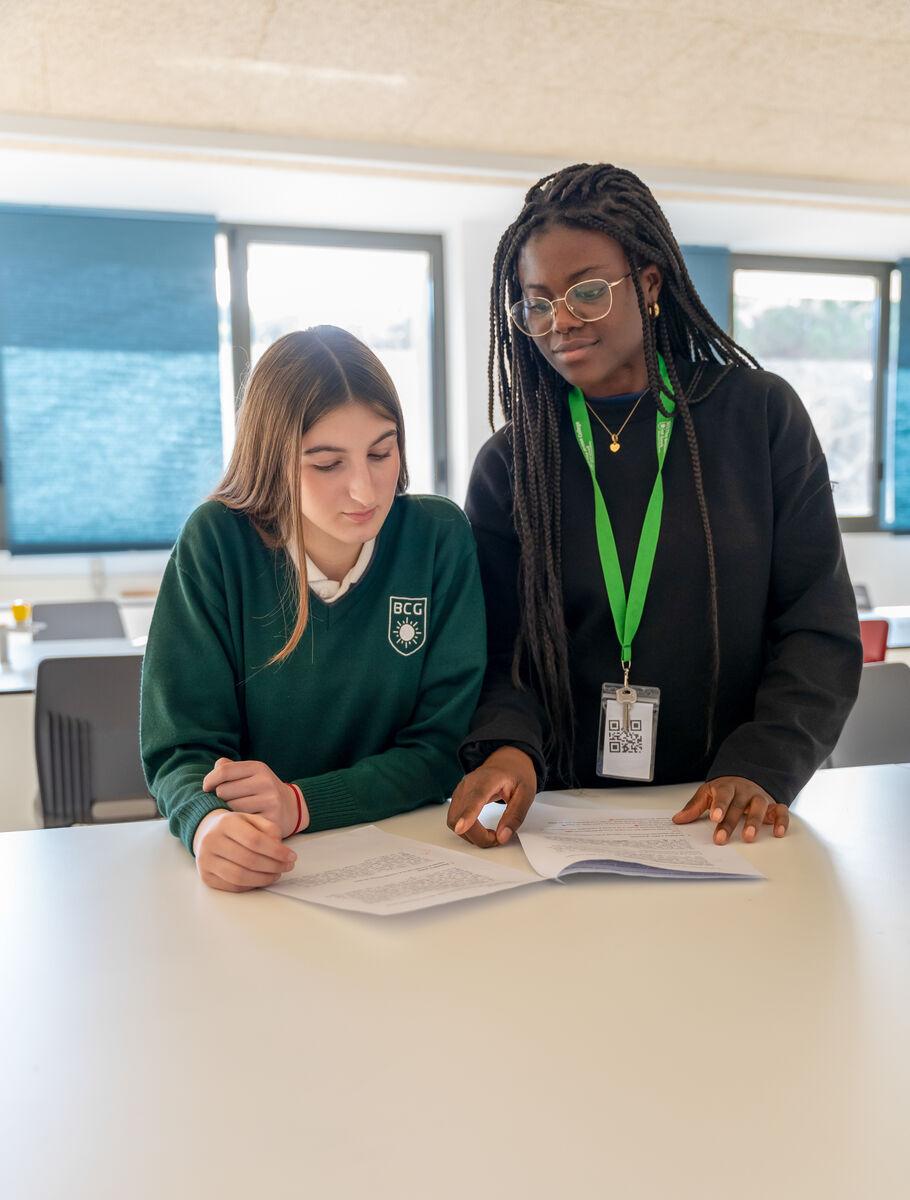
Our IBDP at the British College of Gavà, recognised by Forbes among the top schools in Spain, offers exceptional preparation for any future endeavours. Students benefit from a wide range of subject options beyond traditional disciplines, including strong offerings in the arts and the integration of Education for Sustainable Development within CAS.

With highly committed subject-specialist teachers and small class sizes, students consistently achieve results above the global average, with top scorers reaching 43 out of 45 points.

Personalised university and careers guidance supports learners in exploring courses and careers, developing study and research skills, selecting ideal universities, writing personal statements, and navigating applications. As a result, the majority of our graduates secure places at their preferred universities across Spain, the US, the UK (including Russell Group), and continental Europe. Prestigious destinations include Durham, Warwick, St Andrews, Trinity College Dublin, Bocconi, and Amsterdam, often with scholarships.
Do universities prefer the IBDP

Holistic Development


Our modern, green campus, close to the beach and just minutes from Barcelona airport and city centre, offers an expansive sports complex, state-of-the-art science laboratories, an art suite, music and drama studios, and a multipurpose auditorium, supporting academic, physical, and creative pursuits. Students also benefit from collaborative learning spaces and areas for independent study, with a new Sixth Form centre soon to open as one of the best of its kind in Spain.

BCG's extensive enrichment programme with over 50 activities further develops talents and life skills that set our IB students apart, including sports, performing arts, financial literacy, driving lessons, survival skills, and sustainability for future careers.

how is the IB curriculum
 

The IBDP Curriculum


Our IBDP curriculum in Barcelona spans six subject groups, providing students with a robust academic foundation while allowing them to explore their passions and talents. Students choose three subjects at Higher Level (240 teaching hours) and three at Standard Level (150 teaching hours), ensuring both depth and breadth of knowledge across disciplines, including languages, sciences, humanities, mathematics, and the arts.

The programme is designed to develop students into well-rounded, critical thinkers with a global perspective. Through project-based approaches, active learning, and interdisciplinary study, learners connect theoretical knowledge with real-world applications. The three IB core components—Theory of Knowledge, the Extended Essay, and Creativity, Activity, Service—further broaden their experience and encourage intellectual curiosity, independent research, and personal growth.

IB students receive personalised guidance when selecting subjects, ensuring choices align with their strengths, interests, and future university aspirations. 

IBDP Subjects & Core Components


IB Subject Groups 

At our IB school in Barcelona, the subject selection process ensures students meet the requirements for both the IB Diploma and their intended university courses. Students choose one subject from each of the first five groups, with a sixth subject taken from Group 6 or as an additional subject from Groups 1–5.

We offer an extensive range of subjects across all groups, opening up a wide range of future university pathways:

  • Group 1 – Studies in Language & Literature: English A and Spanish A, offering native-level literary analysis.
  • Group 2 – Language Acquisition: English B, Spanish B, Spanish Ab Initio, and French B, supporting multilingual development.
  • Group 3 – Individuals and Societies: Business Management, Economics, Geography, Global Politics, History, and Psychology, providing insights into society and human experience.
  • Group 4 – Sciences: Biology, Chemistry, Physics, Computer Science, and Environmental Systems & Societies, with hands-on lab work to develop logical reasoning and problem-solving skills.
  • Group 5 – Mathematics: Mathematics: Analysis & Approaches (AA) and Applications & Interpretation (AI), tailored to learning styles and career pathways.
  • Group 6 – The Arts: Theatre, Visual Arts, and Music, nurturing creativity, cultural understanding, and personal expression.

IB Core Components

The IBDP's three core components set it apart from other national and international Sixth Form pathways:

  • Theory of Knowledge (TOK) challenges students to examine knowledge acquisition and evaluate truth claims across disciplines, fostering philosophical reasoning and critical analysis. 
  • The Extended Essay (EE) requires independent research on a topic of personal interest, culminating in a 4,000-word academic paper that builds university-level research and writing skills.
  • Creativity, Activity, Service (CAS) integrates experiential learning beyond the classroom through creative projects, physical activities, and community service. By incorporating Education for Sustainable Development within CAS, we provide opportunities for environmental action and sustainability education. These experiences equip students with transferable skills and practical knowledge, preparing them for the most in-demand careers in a rapidly changing world.
How is the IB assessed

IB Diploma Assessment & Grades


The IBDP assessment system combines internal and external evaluations to provide a comprehensive measure of student achievement. Each subject is graded from 1–7, with a maximum possible score of 45 points. The Theory of Knowledge (TOK) and Extended Essay (EE) components can contribute up to three additional points, rewarding independent and strategic thinking, as well as research skills.

CAS is a compulsory requirement, but does not contribute to the overall score. Internal assessments, conducted by teachers and externally moderated, typically account for 20–30% of the final grade and include lab reports, oral presentations, and art portfolios. External examinations, marked by international examiners, form the majority of the assessment, testing knowledge, understanding, and analytical skills. Rigorous external marking ensures consistency and reliability across IB schools in Barcelona and worldwide.

Learn More About the IB

How is the IBDP structured

IB Teachers


Our IB Diploma teachers at BCG are native English speakers with exceptional qualifications and extensive experience, combining subject expertise with a deep understanding of the IB philosophy and requirements. Many hold advanced degrees and actively engage in professional development to remain at the forefront of international education. Their commitment to innovation and personalised learning ensures that every student receives the guidance and support needed to excel throughout the programme and achieve success in their final examinations.

What makes a successful IBDP student

IB Learner Profile


The IB Learner Profile defines the qualities IB programmes aim to develop, empowering graduates who are inquiring, knowledgeable, thinkers, communicators, principled, open-minded, caring, risk-takers, balanced, and reflective. These attributes extend beyond academic achievement to encompass personal characteristics essential for success at university and in professional life. Our implementation of the IB Learner Profile permeates every aspect of the educational experience, from classroom discussions to extracurricular activities.

What are the requirements to earn the IBDP

Requirements to Obtain the IB Diploma


To be awarded the IB Diploma, students must take six subjects—at least three at Higher Level—along with the three core components: Theory of Knowledge, the Extended Essay, and Creativity, Activity, Service (CAS). They must achieve a minimum of 24 points overall while meeting the required standards in both Higher and Standard Level subjects. In short, students must successfully complete all elements of the programme and demonstrate consistent, satisfactory performance across all subjects.

How does the IBDP differ from A-Levels

IB VS A-Levels and the National Baccalaureate


The IB Diploma Programme (IBDP) emphasises breadth, requiring students to study six subjects across multiple disciplines, complemented by the core components (Theory of Knowledge, the Extended Essay, and CAS), which have no direct equivalent in the A-level curriculum. In contrast, A Levels focus on depth, with students typically taking three or four subjects. While both the IBDP and A Levels are internationally recognised qualifications, the Spanish Baccalaureate is primarily designed to prepare students for Spanish universities.

Students who thrive in the IBDP enjoy intellectual challenge, value connections between subjects, and place importance on personal development alongside academic achievement. The programme is particularly suited to learners motivated by enquiry-based learning, independent research, and meaningful community engagement. Those seeking a broad, globally recognised education that develops both academic and practical life skills will find the IBDP especially rewarding.

BCG

How Does the IB Ensure Its Curriculum Remains Current & Relevant?


The Diploma Programme curriculum undergoes a comprehensive review every seven years to incorporate the latest educational research and global best practices. This process ensures that study programmes and supporting materials remain up to date, providing students with a rigorous, internationally focused education that equips them for success in the 21st century.

Contact Us Today


Discover how our top IB Diploma Programme in Barcelona can prepare your child for success at leading universities and careers worldwide.